
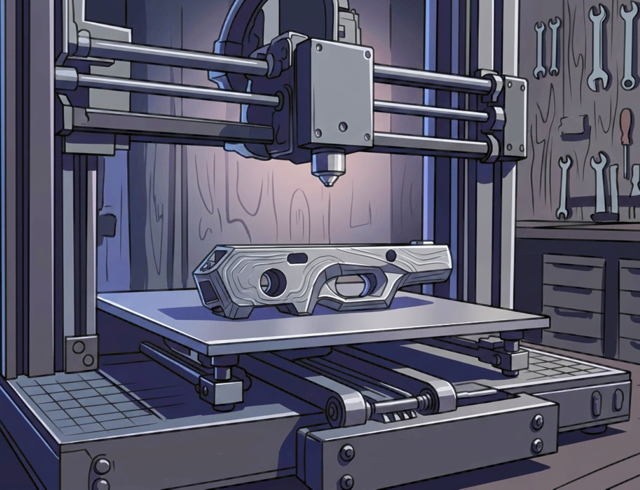
The 3D printer is well on its way to becoming a household staple. Back in the 2000s, the 3D printer market was virtually nonexistent. The barrier for entry was incredibly high. If you wanted a 3D printer you needed to assemble it yourself, in some cases soldering your own circuit boards, and the software to operate it had a steep learning curve. Thanks to tech companies polishing it up and releasing it into the mainstream, it's no longer a niche hobby; from classrooms to cosplayers, the 3D printer has become a staple in the DIY landscape.
If you can think of it, and design it, you can print it. If you can do all those things, you can break the law with it.
3D printed firearms known as "ghost guns" have become an unintended consequence. According to the ATF, law enforcement recovered 92,702 ghost guns between 2017 and 2023, a 44% increase over the last 5 years.
The term 3D printed gun is a misnomer.
Let's say you wanted to "print" a handgun. Actually you're only printing the frame, the grip and the body. Then you buy what is known as a top kit, and a bottom kit. The top kit provides the power (bullet, barrel, firing pin), the bottom kit provides the control (hammer, safety, springs and such). The 3D printed frame holds it all together. You now have a functional handgun that is 100% untraceable.
This is an issue and legislators are right to take it seriously. The question is whether the proposed solutions solve the problem or create new ones.
The top kit and the bottom kit are just pieces of metal. You can buy them at gun shows or online, there's no background check required. The part that gets 3D printed, the frame, is the part that IS regulated. Buying a frame is the same as buying a fully functional gun and involves paperwork, a background check, and it is serial numbered.
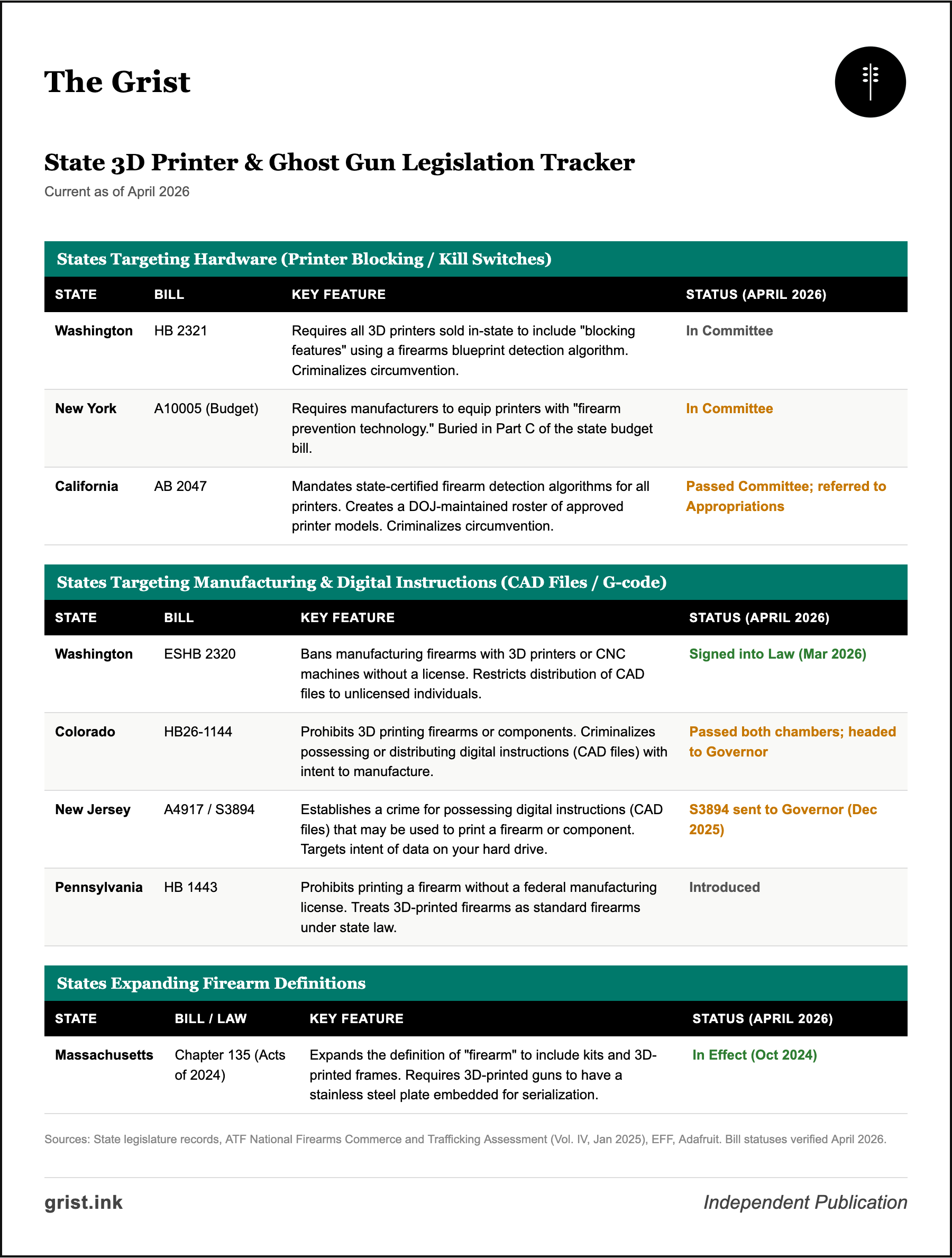
Quite a lot of legislation has been proposed and passed across the country to deal with this. Not all of it great. In the next few years 3D printers are to be built with mandated blocking features. If the software decides your project is 'illegal,' it triggers a killswitch that bricks the machine and potentially reports your location to the authorities.
Needless to say there's a lot wrong with this approach. This is a censorship and anti-privacy nightmare. Not to mention feature creep. It starts with making sure you're not printing gun parts. Then down the road you try to print a replacement part for your stove or a Star Wars toy and it's flagged as an IP violation. False positives are also something that should be taken into account.
That isn't the only approach.
New Jersey passed a bill making possessing digital instructions (CAD files) that could be used to print a firearm or component a crime.
Colorado straight out bans manufacturing and criminalizes CAD files.
Pennsylvania wants a law prohibiting anyone from printing a gun without a federal manufacturing license, making printing guns at home a crime.
Massachusetts expanded the definition of a "firearm" to include kits and 3D-printed frames, Requiring 3D-printed guns to have a steel plate embedded in them for serialization.
You may be asking yourself "wouldn't it be easier to just outlaw top and bottom kits?" That's not possible because those parts are used to repair legally owned guns. There are about 400 million guns in the United States, they can't be expected to file federal paperwork for a four dollar spring. Also, if you come anywhere near resembling a registry the gun lobby vehemently steps in.
There's no clear answer here. The problem is real, the guns are real, and people are dying. Legislators are trying to solve both a technical problem and manufacturing problem. Some of these laws take a real stab at it. Others are downright draconian. This problem needs to be solved without violating everybody else's civil rights. The clock is ticking because 3D printing is getting a lot better and a lot more accessible