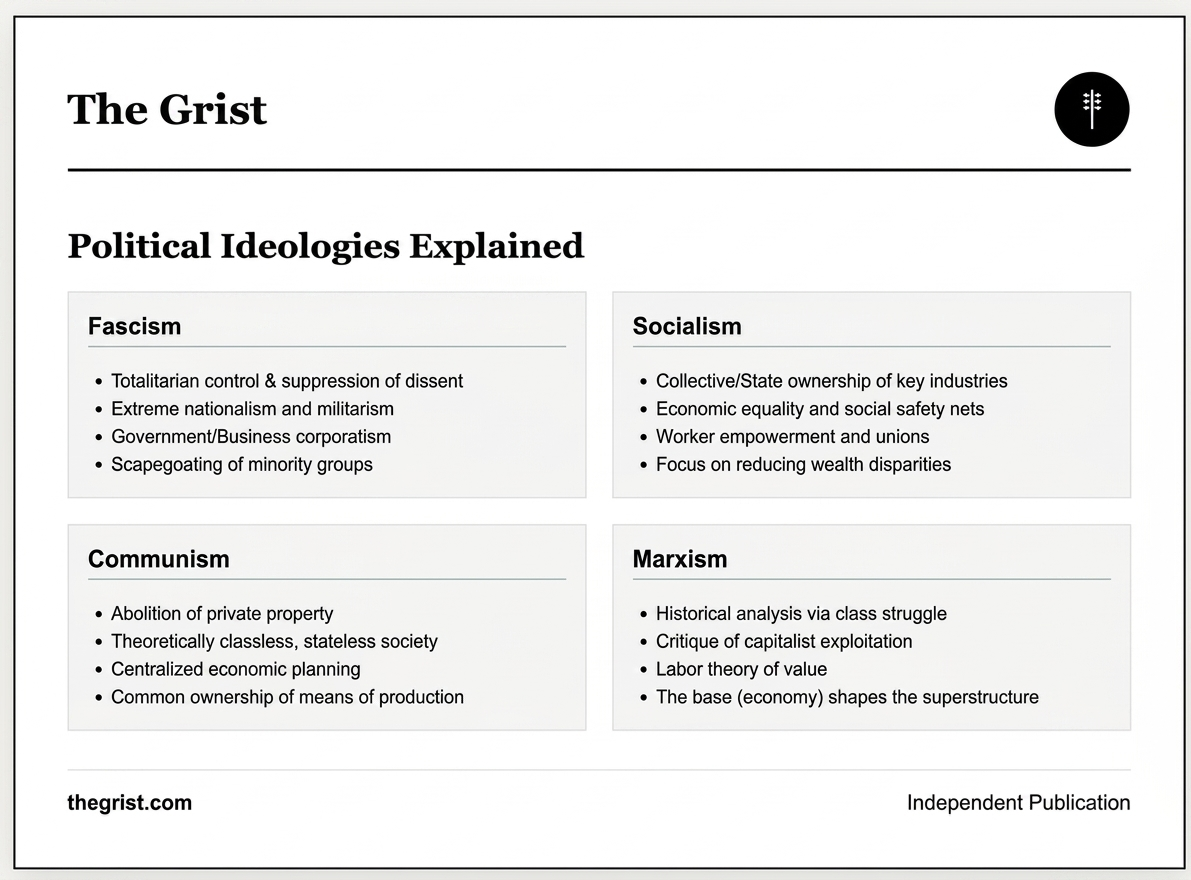
Fascism, socialism, communism. These words are being thrown around quite a bit but not always correctly. Here's an easy to follow list along with the chart on the bottom.
What Is Fascism?
Fascism is a far-right, authoritarian political ideology that emphasizes:
- Totalitarian control – A strong central government with little to no political opposition.
- Nationalism – Often extreme, portraying the nation as superior and needing protection from outsiders.
- Militarism and Violence – Glorification of military power and the use of force to maintain order.
- Suppression of Dissent – Political opponents, the press, and free speech are crushed.
- Corporatism – The government works closely with big business while maintaining strict control over workers and unions.
- Scapegoating – Blaming internal or external groups (immigrants, minorities, political dissidents) for societal problems.
How Does It Work?
- Crisis & Fear – Fascists often rise in times of economic collapse, social unrest, or national humiliation. They exploit fear and promise order.
- Leader Cult – A single leader (or ruling party) is presented as the only solution to the country’s problems.
- Propaganda & Control – State-controlled media and censorship shape public opinion. Education is manipulated to reinforce ideology.
- Crushing Opposition – Political opponents are silenced through intimidation, imprisonment, or violence.
- War & Expansion – Many fascist states seek to expand, believing war is necessary for national strength.
What Is Socialism?
Socialism is a political and economic ideology that emphasizes:
- Collective or State Ownership – Key industries (healthcare, education, utilities) are publicly owned or heavily regulated.
- Economic Equality – Reducing wealth disparities through redistribution, social programs, or worker control.
- Social Welfare – Strong safety nets (healthcare, unemployment benefits, housing, etc.) to ensure basic needs are met.
- Democratic Control – Often supports democratic governance but with economic policies aimed at benefiting the majority.
- Class Struggle – The belief that economic systems should prioritize workers over wealthy elites and corporations.
How Does It Work?
- Critique of Capitalism – Socialism often arises in response to economic inequality, unemployment, or corporate exploitation.
- Government Intervention – The state plays a key role in regulating industries, taxing the wealthy, and funding social programs.
- Public Services Expansion – Universal healthcare, free or low-cost education, and worker protections are central policies.
- Worker Empowerment – Some forms push for worker-owned businesses, unions, and cooperative economic models.
- Varied Implementation – Socialism ranges from democratic socialism (as in Scandinavia) to authoritarian models (as in the Soviet Union).
What Is Communism?
Communism is a political and economic ideology that emphasizes:
- A Classless Society – The elimination of social classes, where wealth and resources are shared equally.
- Common Ownership – The means of production (factories, land, businesses) are collectively owned, with no private property.
- No Government or State – In theory, the state "withers away" as people self-govern, though in practice, communist states have strong central governments.
- Abolition of Capitalism – No private business or market competition; instead, goods and services are distributed according to need.
- Central Planning – The economy is planned by the government, determining production, prices, and wages.
How Does It Work?
- Revolution & Overthrow of Capitalism – Communist movements often begin with a working-class uprising against elites.
- Dictatorship of the Proletariat – A transitional state where the government controls all resources to enforce equality.
- State-Controlled Economy – Production and distribution are planned to ensure basic needs are met for all citizens.
- Elimination of Class & Private Ownership – Over time, wealth is redistributed, and private businesses disappear.
- Theoretical Stateless Society – Eventually, the state dissolves, and society operates collectively without hierarchy (though this has never been achieved in practice).
What Is Marxism?
Marxism is a political, economic, and philosophical framework developed by Karl Marx and Friedrich Engels that emphasizes:
- Historical Materialism – The idea that economic conditions and class relationships are the driving force behind all of human history and social change.
- Class Conflict – Society is fundamentally divided between those who own the means of production (the bourgeoisie) and those who sell their labor (the proletariat), and this conflict is the engine of political change.
- Critique of Capitalism – Capitalism is seen as inherently exploitative, extracting surplus value from workers to generate profit for owners.
- Labor Theory of Value – The value of a good or service comes from the human labor required to produce it, not from market pricing or scarcity.
- Revolutionary Change – Meaningful economic equality cannot be achieved through reform alone; it requires the working class to seize control of the means of production.
- Base and Superstructure – The economy (the "base") shapes everything else in society — laws, politics, religion, culture (the "superstructure") — not the other way around.
How Does It Work?
- Capitalism's Contradicts – Marx argued that capitalism contains the seeds of its own destruction: overproduction, wage suppression, and concentration of wealth inevitably create crises.
- Class Consciousness – Workers must recognize their shared exploitation and organize collectively rather than competing against each other.
- Workers' Revolution – The proletariat overthrows the capitalist class and takes collective control of production and resources.
- Transition Period – A workers' state manages the economy during the shift away from capitalism, redistributing wealth and dismantling class structures.
- Influence on Later Movements – Marxism is the theoretical foundation for communism, many forms of socialism, and a wide range of labor and liberation movements worldwide. Marx himself did not lay out a detailed blueprint for a post-capitalist society — later thinkers (Lenin, Mao, Gramsci, and others) interpreted and applied his ideas in very different ways.
The next time someone throws one of these words around you'll have a better understanding of what they mean even if the person doesn't. it's important to recognize them when they show up in rhetoric.Knowledge is the best defense against misuse.