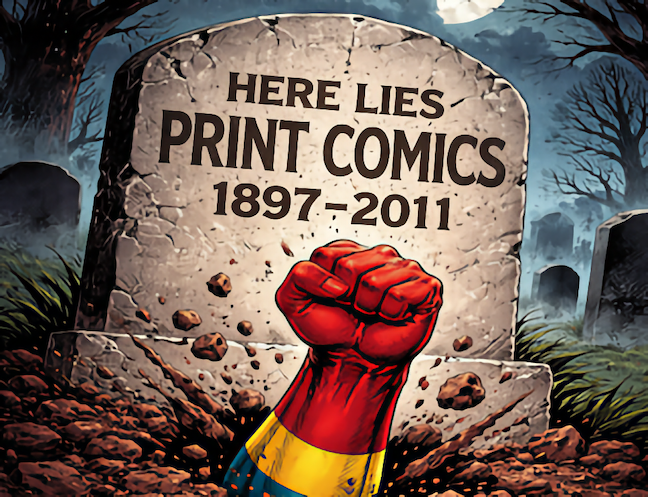
Print has not merely survived the digital era, it's thrived.
Digital really hit the comic book landscape around 2011. That was the year digital comics went same day and date as print.
DC Comics kicked it off on August 31, 2011, when The New52 reboot launched day-and-date digital publishing for all of DC's ongoing titles. Over the next several months other publishers followed suit. Many thought this would be the end of the direct market retailer (comic book stores) and a major blow to the world of print.
Fast forward a few years and we come to find this wasn't the case at all.
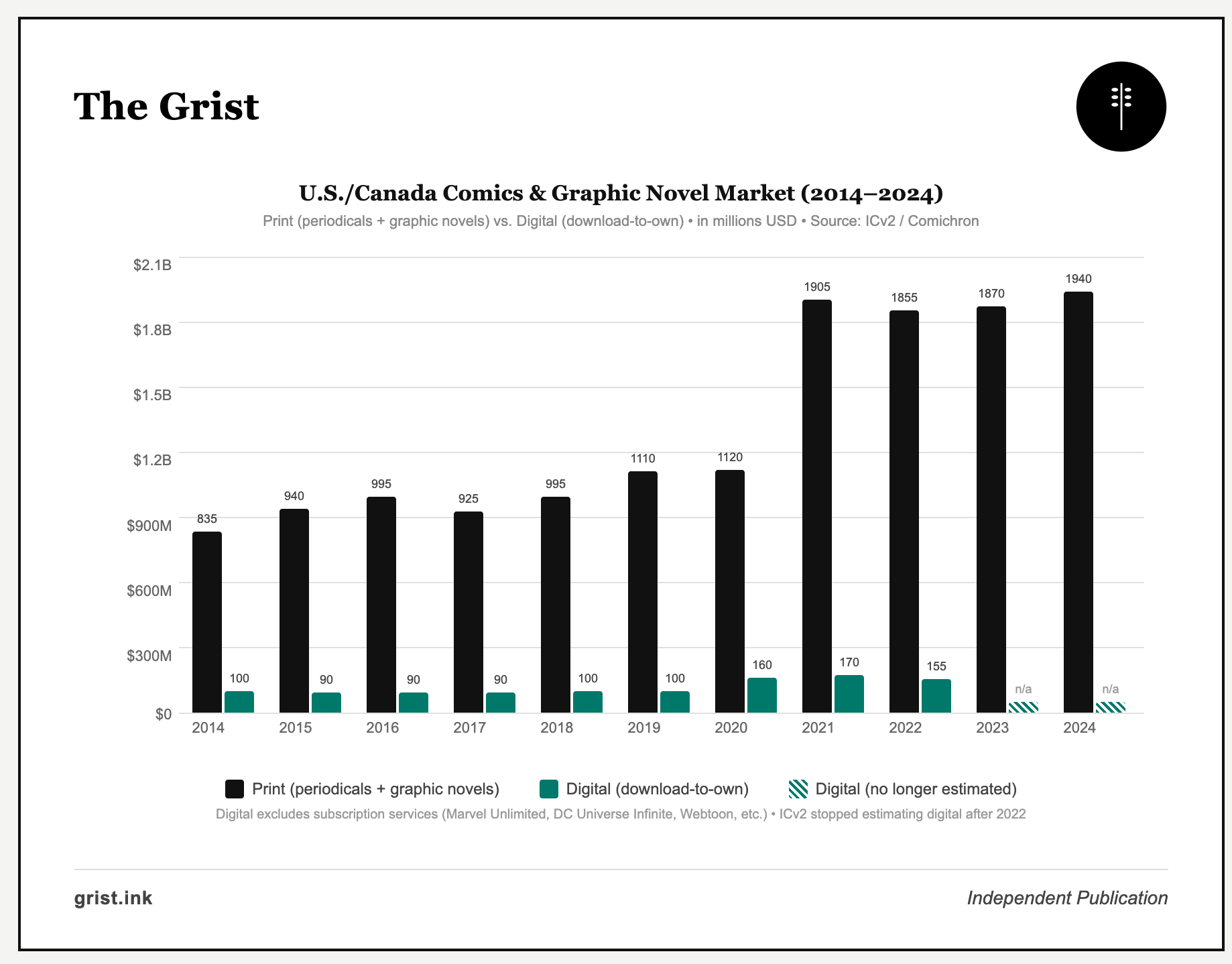
In 2014, the total U.S./Canada comics and graphic novel market was roughly $935 million. Graphic novels made up the lion's share at around $460 million (bookstores, etc). Periodical comics (floppies) accounted for about $350 million, while digital sales were approximately $100 million representing about 11% of the total market. Publishers confidently cited that it was growing and that digital sales would eventually overshadow print.
Come 2015, the total U.S./Canada comics and graphic novel market grew 10% to roughly $1.03 billion. Floppies rose to about $385 million with around $350 million in graphic novel sales. However, digital sales actually dropped to approximately $90 million. Down from the $100 million from 2014, shrinking digital's market share from about 11% to 9%. Even as the overall market was growing, digital was shrinking. Looking around at the rest of the digital landscape, publishers were still bullish.
From 2016 through 2024, the overall U.S./Canada comics market grew from about $1.085 billion to $1.94 billion, nearly doubling in size, but digital sales didn't add to that growth. Digital stayed flat at roughly $90–100 million from 2016 through 2019, briefly spiked to $160–170 million in 2020–2021 (the pandemic years), then fell back to $155 million in 2022. Print meanwhile nearly doubled, with graphic novels surging past $1.4 billion and floppies hitting a 15-year dollar high of $460 million by 2024.
The industry stopped getting reliable digital sales data after 2022. Publishers started keeping numbers close to their vests and Comixology had been absorbed into the black hole of Amazon.
Granted the story is the exception and not the rule. But there are still lessons that could be taken from it. What happened to keep digital comics from taking hold in the industry?
- Physical collectibility: Comic book collectibility has its own thriving ecosystem. Grading, Slabbing, and speculation drive an entire secondary market. You can't bag and board a digital comic.
- Variant covers: Love them or hate them (I hate them). Variant covers are huge and pump a lot of money into the print industry, a revenue stream that digital can't match.
- The bookstore/library channel: This is huge. We're not only talking about your Barnes & Noble but your Targets and Walmarts as well. Kids and young adult comics and graphic novels also move the needle significantly. Kids need books.
- Pricing: When digital comics went same day and date, publishers kept the price identical to print. Part of the reasoning was that digital solved a real problem for international readers who had been waiting two to three months for books to reach them. (That and digital comics were the future.) While great for international readers, domestic ones wouldn't bite.
- American comics artwork is designed for the printed page: It's that simple. If you wanna read a run of something published in the 1980s you're going to have a rough time. Trying to squeeze a splash page or a two page spread onto a mobile phone screen is going to lessen the reader's experience.
- The Wednesday warrior: Dedicated comic book fans who visit comic shops on Wednesdays (new release day) rain or shine. There's a whole cultural aspect to the comic book world. Coming in every Wednesday and talking about what you had read the week before. Getting recommendations and climbing up on the soapbox. You just can't digitize a Wednesday.
The comic book industry's ecosystem turned out to be too deeply rooted in culture, collectibility, and community for the onslaught of digital to upend. This may change over the next decade or so, and other mediums have not been so fortunate. But it does offer a glimmer of hope.