
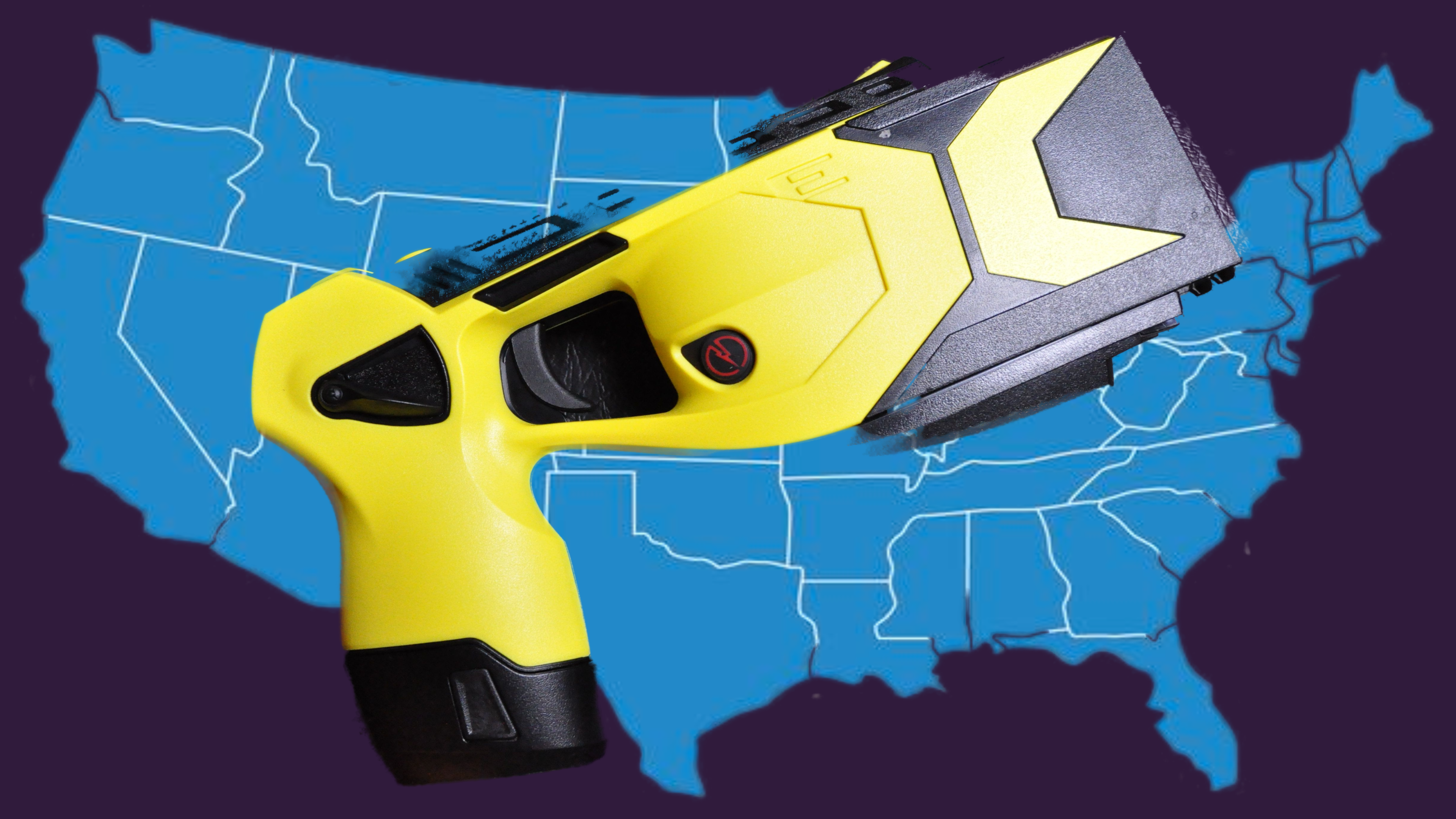
In the 1960's Jack Cover, a former NASA engineer, begins developing a non-lethal weapon inspired by science fiction notably Tom Swift and His Electric Rifle giving us of the acronym TASER.
Back then it fired its probes with the help of gunpowder, Classifying it as a firearm. This resulted in limited adaption through the 70s and 80s.
Once the 90s came along gunpowder was switched out for compressed nitrogen. No longer making it legally a firearm. opening the floodgates for widespread police use. In 2011 Amnesty International published a report siding concerns over the widespread use of tasers based on cases they examined.
- Excessive and inappropriate use of force - used in situations where suspects are unarmed or resisting passively
- Overuse for minor/non-threatening situations - deployment to de-escalate a minor public disturbance or verbal resisting
- Use against vulnerable populations - mentally ill, intoxicated, elderly and teenagers.
- Multiple or repeated shocks - repeated use after a suspect effect has been subdued.
- Risk of death and medical uncertainty - studies hadn't been done on the effect of electric shock on an alcohol or drug ridden individual
- Lack of regulation and oversight - deploying a taser was treated with the same regard as taking out the night stick
- Weak transparency and data gaps - departments were not required to report any usage statistics.
- Potential for abuse due to “pain compliance” design - tasers can inflict great pain with minimal visible injury.
Since the report in 2011 things have gotten better but not great. As of this writing there is no federal law mandating the use of tasers. It's left up to the states to decide how they want to handle these concerns. Some states do it statewide some actually leave it up to the municipalities to decide. The chart below breaks down the rules state by state.
| High Oversight — Statewide rules + reporting + strong oversight | |||||
| State | Taser Rules | Supervisor | Reporting | Medical | Takeaway |
|---|---|---|---|---|---|
| California | Partial | Yes | Yes | Yes | De-escalation required, expanding limits |
| Colorado | Yes | Yes | Yes | Yes | Strong reform laws in place |
| Illinois | Partial | Yes | Yes | Yes | Increasing statewide oversight |
| New Jersey | Yes | Yes | Yes (statewide) | Yes | Strict, standardized oversight |
| Washington | Yes | Yes | Yes | Yes | Detailed statewide use-of-force laws |
| Moderate Oversight — Some statewide rules, local variation | |||||
| State | Taser Rules | Supervisor | Reporting | Medical | Takeaway |
| Connecticut | Yes | Yes | Yes | Yes | Strong reporting requirements |
| Delaware | Partial | Yes | Yes | Yes | Some statewide guidance |
| Hawaii | Partial | Yes | Yes | Yes | Regulated but limited scope |
| Maine | Partial | Yes | Yes | Yes | Smaller system, moderate rules |
| Maryland | Yes | Yes | Yes | Yes | State standards with local variation |
| Massachusetts | Partial | Yes | Yes | Yes | Certification + oversight model |
| Michigan | Partial | Yes | Yes | Yes | Mixed oversight |
| Minnesota | Partial | Yes | Yes | Yes | Post-reform oversight improving |
| Nevada | Partial | Yes | Yes | Yes | Structured but not uniform |
| New Hampshire | Partial | Yes | Yes | Yes | Limited but present oversight |
| New Mexico | Partial | Yes | Yes | Yes | Mixed oversight |
| New York | No (local) | Common | Yes (internal) | Yes | Depends on department |
| Oregon | Partial | Yes | Yes | Yes | State guidance, local control remains |
| Rhode Island | Partial | Yes | Yes | Yes | Smaller system, moderate controls |
| Utah | Partial | Yes | Yes | Yes | Moderate but not strict |
| Vermont | Partial | Yes | Yes | Yes | Statewide Taser policy enacted |
| Virginia | Partial | Yes | Yes | Yes | Moderate reforms in place |
| Wisconsin | Partial | Yes | Yes | Yes | Moderate but inconsistent |
| Low Oversight — Mostly local policy | |||||
| State | Taser Rules | Supervisor | Reporting | Medical | Takeaway |
| Alabama | No | Varies | No | Varies | Minimal structure |
| Arizona | No | Varies | No | Varies | Department-driven policies |
| Arkansas | No | Varies | No | Varies | Low formal oversight |
| Florida | No | Varies | No | Varies | Minimal statewide rules |
| Georgia | No | Varies | No | Varies | Limited oversight |
| Indiana | No | Varies | No | Varies | General standards only |
| Iowa | No | Varies | No | Varies | Local control |
| Kansas | No | Varies | No | Varies | Minimal state role |
| Kentucky | No | Varies | No | Varies | Sparse oversight |
| Louisiana | No | Varies | No | Varies | Limited statewide rules |
| Mississippi | No | Varies | No | Varies | Local discretion |
| Missouri | No | Varies | No | Varies | Mostly local |
| Nebraska | No | Varies | No | Varies | Limited guidance |
| North Carolina | No | Varies | No | Varies | Mostly local rules |
| Ohio | No | Varies | No | Varies | Local policies dominate |
| Oklahoma | No | Varies | No | Varies | Department-based policies |
| Pennsylvania | No | Varies | No | Varies | Highly decentralized |
| South Carolina | No | Varies | No | Varies | Sparse statewide guidance |
| Tennessee | No | Varies | No | Varies | General standards only |
| Texas | No | Varies | No | Varies | Local control dominates |
| West Virginia | No | Varies | No | Varies | Limited structure |
| Minimal Oversight — Almost entirely local control | |||||
| State | Taser Rules | Supervisor | Reporting | Medical | Takeaway |
| Alaska | No | No | No | Minimal | Limited statewide policy |
| Idaho | No | No | No | Minimal | Minimal oversight |
| Montana | No | No | No | Minimal | Very limited structure |
| North Dakota | No | No | No | Minimal | Sparse regulation |
| South Dakota | No | No | No | Minimal | Local control dominates |
| Wyoming | No | No | No | Minimal | Almost entirely local |
State: The U.S. state being evaluated.
Rules: Whether the state has policies governing how tasers can be used, or whether those rules are left to local departments.
Supervisor: Whether a supervising officer is required to respond to, review, or approve a taser use incident, either on-scene or after the fact.
Reporting: Whether taser deployments must be formally documented and entered for oversight or review.
Medical: Whether medical evaluation or emergency services are required or strongly recommended after a taser is used on a person.